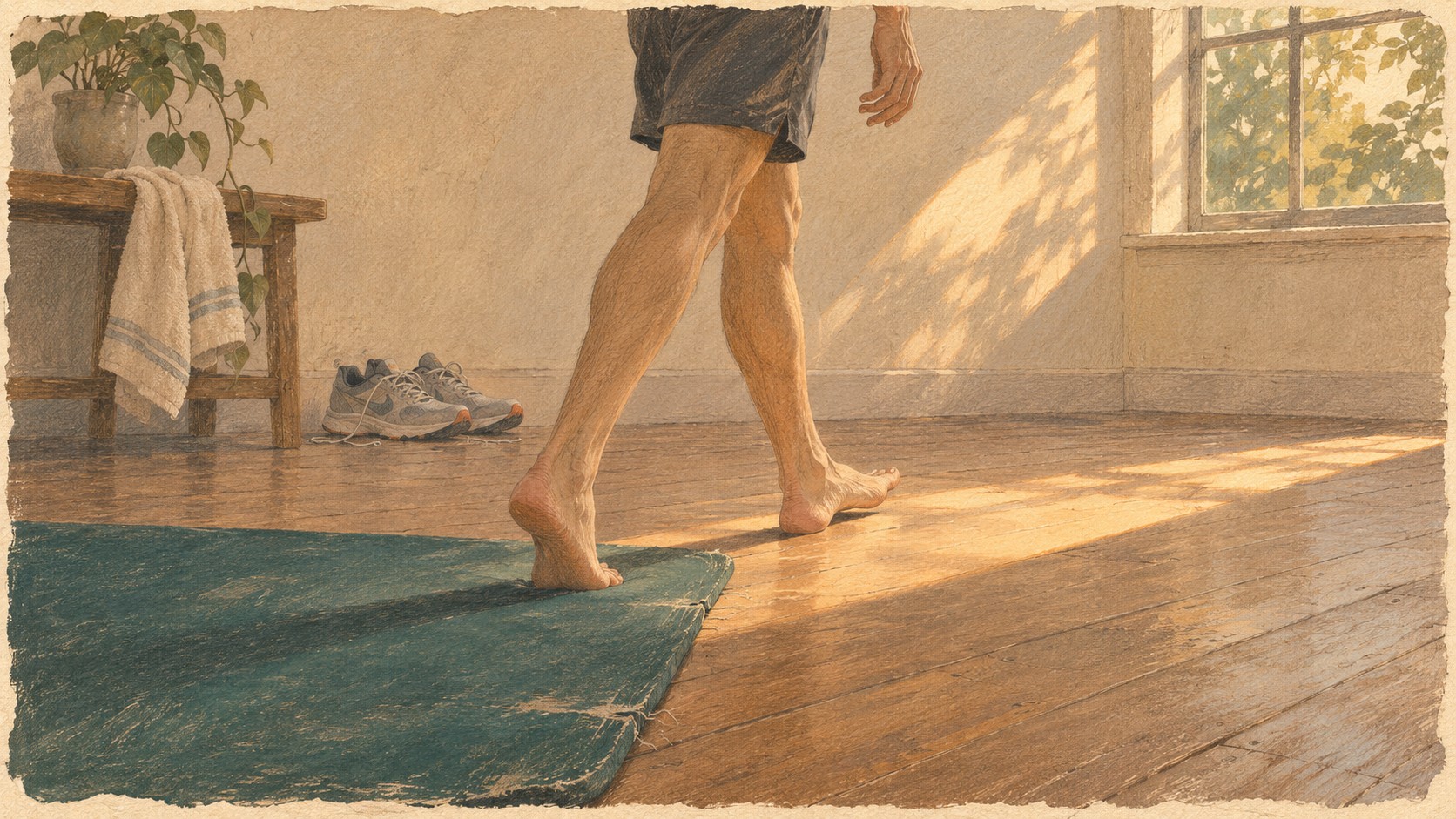
While my foot was recovering, I switched from running to pull-ups, push-ups, and squats. Then my arm started to bother me, and I wondered whether I had overdone it again. I had found three new exercises and brought the same habit to all of them.
The habit has served me pretty well. In 2025 I ran the half-marathon distance nine times, with a best time of 1:40. When I wrote about that year, I gave a lot of credit to one modest promise: run at least 100 km a month. On a busy week, that promise helped me get out the door. Only recently did I notice the two words doing most of the work: at least. I have plenty of practice following a plan that tells me how much is enough to get credit. I have considerably less practice following one that tells me when I’m done.
At 21.1 km, somebody else has already settled the question. I can stop my watch, walk for a bit, and feel perfectly satisfied. It doesn’t trouble me that I might have managed 21.2. Nobody asks a half-marathon finisher why he left another hundred meters in his legs.
A set of push-ups has no such finish line. Say I plan to do ten. At eight, ten still seems like a perfectly respectable number. At ten, if I can feel an eleventh in me, the arithmetic changes. What would one more cost? Probably very little. And if I stop now, a small, annoying part of me wants to know why.
What interests me is how readily I take that voice’s side. Before the set, I had the rest of my week in mind, including the rather obvious fact that I was doing push-ups because my foot was recovering. Down on the floor, the only piece of information that seems especially relevant is that my arms can do another one. Both versions of me are trying to train well. One of them has a remarkably short memory.
I don’t know exactly what happened to my arm. I do know what question I asked afterward: why do I keep going until I find a physical reason to stop? It’s easy to explain a set that ends because I can’t do another rep. A set that ends because I decided beforehand that ten would do leaves me with no evidence of how hard I could have worked. Apparently I miss that evidence more than I would have guessed.
So here’s the small experiment I want to try. For a workout where the point is simply to do the planned work, I’ll give the last rep a number before I start. If it feels like too much, I can stop earlier. If it feels easy, that’s useful information for planning the next session. It doesn’t have to become an eleventh push-up today.
I’m still proud of learning to keep going over the last few kilometers of a half. That took patience. This feels like a slightly more advanced kind of self-control, mostly because it asks me to do something less satisfying. There’s no new distance on the watch, and no good story about the extra effort. There’s just the tenth push-up, my feet coming forward, and me standing up while I still could have done one more.